The Pipeline Integrity Playbook: Fix Lead Quality, Speed, Compliance, and Attribution

September 3, 2026
Chelcea Fowler
Director of Growth Marketing & Partnerships

Post Contents

Executive Summary

Enterprises have a pipeline problem. 

Pipeline numbers look strong. Marketers are hitting their targets, and the database continues to grow. But revenue doesn’t follow. Somewhere, somehow, there’s a disconnect between lead volume and closed deals. 

Pipeline integrity means every lead entering the CRM/MAP is accurate, compliant, and genuinely qualified, not just another record in the system. Achieving pipeline integrity is possible, but you’ll need a playbook for how to prevent bad data ingestion, detect issues early, and continuously improve data quality. 

Whether you’re building a pipeline from scratch or trying to stop leaks in the pipeline you already have, this guide will lay out: 

Key Takeaways

  • According to Salesforce, 79% of leads never convert. The problem isn’t volume; it’s what enters the pipeline. 
  • There are four failure points that break pipeline: bad data, slow routing, compliance gaps, and no attribution. All of these break upstream of where most teams are looking.  
  • High-growth organizations are nearly 4x more likely to rate their governance maturity as Advanced or Leading, and the gap isn’t explained by the tools they use (Integrate/Demand Metric 2026). 
  • The pipeline integrity standard (quality, speed, compliance, measurability) is what separates demand gen from demand that generates revenue. 

Chapter 1: What’s Actually Broken In Your Pipeline?

Most enterprises have little trouble collecting leads. Teams hit their lead goals consistently, vendors provide leads at scale, and yet the sales pipeline is still broken.  

There are plenty of leads in it, but because those leads are inconsistent, the pipeline underperforms and remains unpredictable.  

According to DemandScience, 79% of leads never convert, and 87% of intent signals are unreliable. The numbers reveal the scope of this pipeline problem. 

Even with that investment, pipeline returns remain stubbornly inconsistent, hitting organizations where it hurts: revenue. 

Teams know it, too:
In our 2026 research with Demand Metric, over 77% of respondents reported spending 10%-50% of their team’s capacity cleaning and reconciling data before they could use it meaningfully. Even with that investment, pipeline returns remain stubbornly inconsistent, hitting organizations where it hurts: revenue.

Why Are Leads Coming In But Revenue Isn’t?

The dashboard looks fine. Lead volume is up. Your team is doing what they’ve been tasked to do. 

But revenue just doesn’t line up. Forecast calls are uncomfortable, and the sales team keeps pushing back on the quality of the leads.  

The root of the pipeline problem is bad lead data that directly stifles revenue.  

The issue is structural: according to our research, most marketing teams already reject up to 20% of vendor leads as duplicates, noncompliant, or irrelevant. For some organizations, this figure reaches 30% or higher. 

And DemandScience reports that 85% of marketing teams spend more than half their time fixing issues instead of building programs, which means the structural lead data quality  


What Do the Best Pipeline Teams Do Differently? 

The teams that get the best, most consistent results from their pipeline pay attention to what they allow into it.  

Too often, teams reduce “demand generation” to a numbers game: more leads equal more success. But there’s a difference between raw-number demand generation and demand that generates revenue. 

That difference is pipeline integrity. 

Instead of focusing on building the widest possible pipeline, enterprise marketing ops and demand gen teams should craft a pipeline that generates more revenue, more consistently, even if that means lower lead counts. 

This conclusion leads to a crucial question: Where does pipeline integrity break down? 

Our research shows four key places enterprise pipelines leak revenue, and in the next chapter, we’ll show you how to identify them.  

Chapter 2: Where Exactly Is Your Pipeline Leaking Revenue? 

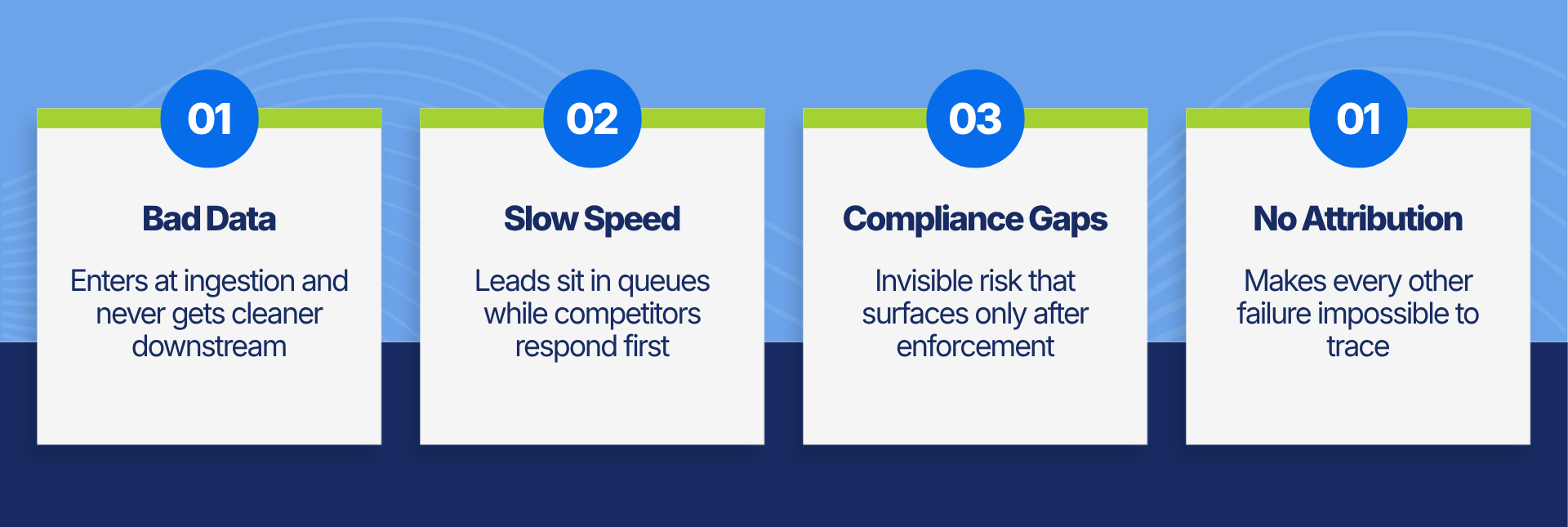
In our research, we’ve identified four key failure points that show up consistently in broken pipelines: 

  1. Bad data at ingestion 
  2. Slow speed-to-lead 
  3. Risky compliance exposure 
  4. Weak or nonexistent attribution 

All four happen upstream of where most teams are looking for leaks. 

Any one of these is enough to threaten pipeline integrity, but they don’t tend to travel solo. Usually, they show up in groups and feed off each other, each amplifying the impact of the others.
What Happens When Bad Data Enters at Ingestion? 

Taking in bad data is the foundational failure of nearly every broken pipeline. If data integrity starts bad, it’s not going to get better as it flows through the pipeline. 

Organizations know their data is weak:  

  • 77% of organizations rate data quality as average or worse, leading to a 25% loss of revenue annually (Integrate.io) 
  • A full 64% of organizations still ingest vendor leads via email attachments and spreadsheets (Integrate/Demand Metric 2026). 

When organizations allow bad data to enter the MAP or CRM, it stops being a data problem and transforms into a revenue problem. And once it’s in the system, it’s nearly impossible to fully clean up midstream.

The Integrate difference:
Integrate cleans up data at the source. Integrate's governance layer validates, enriches, and deduplicates every lead at ingestion, so bad data never has the chance to compound.

Why Does Slow Speed-to-Lead Kill Deals? 

In B2B, speed sells. According to SERP Sculpt, businesses that respond to B2B leads within 5 minutes are 21x more likely to qualify the lead than those that don’t. But across a range of B2B organizations, average lead response time was 42 hours.  

Every hour of delay compounds the cost and decreases the likelihood of converting.  

Speed issues masquerade as sales process issues. But take off the mask, and there’s virtually always a pipeline integrity issue underneath. 

Leads sit in spreadsheets, vendor QA queues, and manual processing pipelines waiting to be cleaned and loaded. Why? Because teams know they can’t trust the data (remember, these failure points compound the others).  

The slow speed-to-lead has at least as much to do with pipeline integrity as it does sales performance.

The Integrate difference:
 Integrate eliminates the manual processing queues (spreadsheets, vendor QA backlogs, field mapping) that are the actual bottleneck between lead creation and sales contact. By eliminating steps between ingestion and sales, Integrate helps teams increase speed-to-lead and win more leads.  

Where Does Compliance Exposure Hide? 

Compliance is a unique structural risk because failures remain invisible. Until they aren’t.  

Compliance failures rarely disrupt day-to-day operations on their own, which means they usually go unaddressed in the background. Manual compliance processes become an afterthought: the first element to skip when volume spikes.  

Of course, that only increases the risk of enforcement actions that disrupt operations if your business is found out of regulatory compliance. And regulations continue to grow in number and complexity:  

  • In the U.S., 20 states now enforce their own comprehensive privacy statutes as of May 2026 (IAPP), more than double just one year ago.  
  • California’s fines under CCPA doubled in 2025, reaching up to $7,988 per incident (CCPA). 

Compliance adds even more weight for enterprises with E.U. operations, as The E.U. AI Act goes into full force on August 2, 2026, with penalties up to €35M or 7% of global turnover, according to Kiteworks. 

Manual processes are hard to maintain and easy to skip. Enterprises need an automated upstream solution that solves for this risk. 

The Integrate difference:
Manual review steps get skipped when volume spikes, creating compliance exposure. Integrate automates compliance at the source, so it’s always enforced and non-negotiable. 

Why Does Weak Attribution Compound Everything Else? 

Leads with weak or nonexistent attribution put blinders on your pipeline processes. Without attribution, the other failure modes become invisible. For example, you can’t verify compliance on a lead if you can’t establish where that lead came from.  

High-growth teams recognize this. They’re nearly 4x more likely to enforce standardized vendor intake requirements (including clean metadata). This standardization forms the foundation that makes attribution possible. 

Attribution loss happens primarily in two scenarios:  

  • Source metadata is weak or nonexistent. 
  • Tools and systems fail to preserve metadata at ingestion.  

Capturing source metadata at ingestion is key, because no downstream data analytics tool can recover or rebuild it later on. If you lose it at ingestion, you’ve lost it for good.  

The Integrate difference:
Integrate preserves source metadata at ingestion, because if it isn't captured at the point of entry, no downstream analytics tool can reconstruct it. 

Chapter 3: How Much Does a Broken Pipeline Actually Cost You? 

In the oil and gas industry, a broken pipeline is a crisis with visible, compounding costs: resources lost, downstream bottlenecks, and personnel aggressively reassigned to stop the leak. 

A broken pipeline in demand gen is a different kind of crisis, but equally critical.  

Instead of fuel, you’re leaking revenue. But the urgency ought to be the same, because the longer your pipeline stays broken, the more your costs compound. 

Every quarter the problem goes unaddressed equals more leads lost. More time spent chasing down details that could’ve been verified automatically. More resources burned on bad leads you could’ve spotted.  

There is a significant gap in governance maturity between high-growth organizations and the rest of the field. Fifty-seven percent of high-growth organizations rate their governance maturity as Advanced or Leading, compared to just 14% in the rest of the field.  

That’s a 4x difference; one not explained by which tools an organization uses (Integrate/Demand Metric 2026).


What’s the Real Bill for Doing Nothing? 

The missed opportunities in enterprise marketing aren’t theoretical. Opportunities you missed last quarter are now your competitors’ customers instead of yours. Put bluntly: the time, revenue, and resources lost this quarter never come back 

Even worse, those losses compound. The revenue you missed could’ve been reinvested. The extra resources you spent because of broken processes could’ve been spent pursuing additional leads.  

Bad data, slow routing, compliance gaps, and attribution loss all combine to create a compounding liability. 

Just how significant is this compounding bill? The Interactive Marketing Bureau (IAB) estimates that fixing measurement could unlock $26B in media investment and $6.2B in productivity. 


Can AI Fix a Broken Pipeline? 

If you’re dealing with broken processes built on data you can’t trust, you won’t get out of the jam by adding AI to the mix. 

AI is a force multiplier, a jolt of speed and power that pushes you farther and faster in whatever direction you’re heading. But it isn’t magic 

If you apply a force multiplier to something broken, you’re just multiplying a broken system, compounding those issues further and further downstream. 

AI-ready data governance is crucial, and our 2026 research with Demand Metric confirms it: high-growth organizations are more than 3x as likely to have formal AI governance frameworks in place and 2x as likely to report that 75% or more of their data is AI-ready.  

So to get real value from AI in enterprise marketing (and not just move faster in the wrong direction), organizations need to stop looking at AI as a magic fix.  

Instead, they should focus on getting their data right, starting with redefining their non-negotiables for every new lead.  

Chapter 4: What Are the Four Negotiables for Every Lead? 

To win on pipeline integrity, enterprises need to reframe what they consider an acceptable lead.  

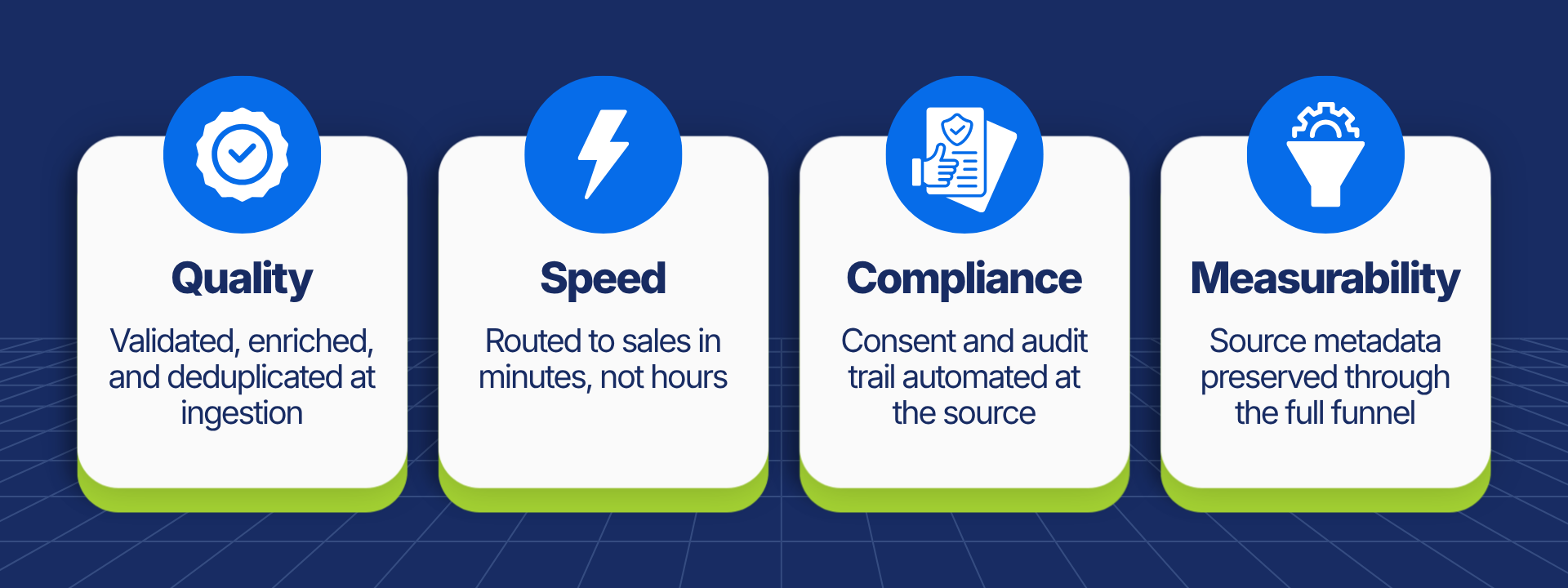
Leads that perform well throughout the pipeline (and that make your organization AI-ready) share four non-negotiables. 

Together, these four elements form an integrated standard. Leads that qualify on all four can safely enter your revenue engine. Leads that miss on any (even just one) will create or widen the leaks in your pipeline.
What Does Quality Mean at Ingestion? 

Instead of accepting bad data (the first place your pipeline is leaking revenue), enterprises must insist on quality from the start. Clean data has to happen at ingestion, not after it’s already polluted the system. 

This level of quality, where every lead is validated, enriched, and deduplicated at ingestion, takes more than just a new software tool.  

It’s a discipline already embedded in the highest performers: our research found that 79% of high-growth organizations automate validation before CRM ingestion. For lower-growth companies, this figure was just 44%. 


How Fast Should Leads Actually Move? 

According to 6sense, 95% of the time, the winning vendor is already on the Day-One shortlist. 

In other words, speed is a competitive issue, not just an operational obstacle. Often speed becomes the difference-maker in whether you close the lead or the competition beats you to it. 

But leads don’t move when they’re sitting in spreadsheets, vendor QA queues, and manual processing pipelines. 

Enterprises that automate ingestion and routing eliminate those manual steps. They route leads to sales in minutes, not hours or days, keeping hot leads hot and giving downstream teams the opportunity to reach and close clients faster. 


What Does Compliance Automation Actually Require? 

As enterprises collect ever-increasing numbers of leads, compliance becomes harder to manage. According to Secureframe, 85% of executives say compliance complexity has increased, and 72% say it’s hurting profitability, meaning compliance is a boardroom issue, not just a legal box to check. 

To patch up a leaky pipeline with compliance issues, organizations must enforce compliance policy at the channel level, before the lead enters the system. 

Making this change is the most reliable way to reduce compliance exposure and the related financial and reputational risks.  

Growth also appears to correlate with tighter vendor intake requirements. Our research shows that high-growth orgs are almost 4x more likely to enforce standardized vendor intake specifications. 


How Do You Preserve Measurability Through the Funnel? 

If having weak or no attribution is like blinders, then solving attribution with source metadata preserved through the full funnel is more like x-ray vision. The question is how to execute this kind of measurability.  

Organizations can achieve closed-loop lead attribution only when they build it into lead ingestion.  

The high-growth organizations that do this well are 3x more likely to report sales acceptance rates over 80% than the rest of the field. This downstream result reveals upstream discipline. 

If you don’t capture attribution at the point of entry, no downstream tool can reconstruct it. But when you do, that’s when the insights and AI use cases start compounding. 


Chapter 5: What Do Pipeline Integrity Leads Do Differently? 

We’ve seen the most common places where enterprise pipelines leak, the cost of those leaks, and the four non-negotiables enterprises should insist on.  

Now we need to answer the question: What do high-performing pipeline integrity leaders do that sets them apart? 

Throughout our research, one conclusion keeps showing up. The tools organizations use aren’t enough to explain the difference between high- and low-growth organizations. The difference is operational discipline, specifically, how they govern data before it enters those tools. 
High-Growth vs. Lower-Growth Organizations
Governance Indicator High-Growth Orgs Lower-Growth Orgs
Governance maturity rated “Advanced/Leading” 57% 14%
Strongly enforce standardized vendor intake 39% 10%
Automate validation before CRM ingestion 79% 44%
Real-time or near-real-time lead delivery 45% 17%
Sales acceptance rate of 80%+ 31% 9%
75%+ of data is AI-ready 24% 10%
Formal AI bias/fairness governance framework 29% 10%
Source: Integrate/Demand Metric, State of the Marketing Data Governance Gap, 2026

Pipeline integrity leaders consistently operate using four key principles: 

  • Govern lead data at ingestion 
  • Route leads at speed 
  • Measure source to revenue 
  • Treat governance as infrastructure, not overhead 


How Do Leaders Govern Data at Ingestion? 

Pipeline integrity leaders insist on strict rules at ingestion. They don’t allow leads into the MAP/CRM if they don’t meet that standard.  

And this insistence pays off: high-growth organizations are nearly 4x more likely to strongly enforce standardized vendor intake requirements. 

Integrate is the governance layer organizations use to automate governance at ingestion, not later.  


How Do Leaders Route Leads at Speed? 

Pipeline integrity leaders regularly route leads in seconds, not hours or days. They don’t allow leads to flounder in spreadsheets or manual qualification processes. 

Once again, a clear difference emerges between high- and low-growth companies: organizations marked by high growth are 2x more likely to deliver leads in real time. 

Integrate makes real-time lead routing the default, not the exception. 


How Do Leaders Measure Source to Revenue? 

Pipeline integrity leaders trace leads from ingestion to revenue with clear, measurable data. No more mystery or guesswork about what happens at points in between. 

High-growth organizations demonstrate this capability by being 3x more likely to report 80%+ sales acceptance rates. Sales teams view more leads as acceptable because the data gives them the confidence to do so. 

Integrate preserves the data that enables full-pipeline traceability, unlocking true measurement of source to revenue. 


Do Leaders Treat Governance at Infrastructure? 

Pipeline integrity leaders treat governance as core infrastructure. Where others look at governance like an overhead cost to be minimized, pipeline integrity leaders consider it one of the business’s non-negotiable core functions. 

The highest performers understand the level of investment required. High-growth organizations are substantially more likely to allocate 50%+ of their martech budget to lead management and governance functions. 

When organizations adopt and execute the pipeline integrity standard, results follow: 

  • 50% more sales-qualified leads at 33% lower cost (SHNO) 
  • 3x faster average deal close (Ebsta) 

These are measured, documented results, not projections. Adopting the pipeline integrity standard and rigorously enforcing it can unlock similar performance gains for your organization, too. 


Chapter 6:  How Does Integrate Deliver Pipeline Integrity? 

Integrate delivers pipeline integrity by bringing every demand channel into one platform, with one unified standard. With Integrate, every lead from every source enters the revenue engine clean, compliant, and traceable. 

We do this across three pillars: Clean Data, Faster Action, and a Pipeline that Converts. 


Clean Data 

Integrate validates, enriches, and deduplicates every lead at ingestion, across every channel. Because bad data never enters the system, it never gets the chance to compound, slow you down, create compliance concerns, or obscure measurability. 


Faster Action 

Integrate automates ingestion, transformation, and routing, so clean leads arrive in minutes, replacing the manual work that 64% of teams are still doing via email attachments and spreadsheets. Faster speed-to-lead keeps hot leads hot and helps sales teams close deals more consistently. 


Pipeline That Converts 

Integrate maintains closed-loop attribution by channel, source, and campaign. Teams can capture and control every inbound lead with confidence and transparency. With Integrate’s governance software, every dollar is provable, every underperformer is visible, and every optimization decision is grounded in real conversion data. 

Clean data moves faster. Faster data converts. Better analytics tell you where to do it again. 


Chapter 7: How Do You Measure Pipeline Integrity? 

A governance program that isn’t measured tends to drift back into the reactive, cleanup-driven pattern it was built to replace. The organizations that sustain pipeline integrity track a small, consistent set of metrics, tied directly to the four non-negotiables from Chapter 4. 

Which KPIs should you track
KPI What It Tells You What High-Growth Orgs Report
Pre-CRM validation rate How much bad data you're catching before it pollutes the system 79% automate this step
Vendor lead rejection rate How much upstream discipline exists at the intake stage Most reject 6–20% monthly
Speed-to-lead Whether hot leads are reaching sales while they're still hot Real-time delivery: 45%
Sales acceptance rate Whether sales trusts the data enough to act on it 31% report 80%+ acceptance
AI-ready data coverage Whether your data foundation can support AI use cases 24% report 75%+ AI-ready
Governance budget as % of martech spend Whether governance is funded as infrastructure 14% allocate 50%+

How Often Should You Review These Metrics? 

At a minimum, quarterly, and immediately when you add new lead sources, change ICP criteria, or see new patterns in rejected leads. 

Treat validation rules and KPI targets as a living part of the system, not a one-time configuration. The moment a KPI moves outside its normal range (a spike in rejection rate, a drop in sales acceptance) is your earliest signal that something upstream has changed before it shows up in revenue. 


Chapter 8: How Do You Get Internal Buy-In for Pipeline Integrity? 

Pipeline integrity competes for budget against every other line item in the martech stack. Winning that argument means translating governance from a compliance checkbox into a revenue lever leadership can see and measure. 


Who Needs to Be in the Room? 

Pipeline integrity touches more functions than marketing ops alone, and buy-in works best when those functions are looped in early rather than asked to react after the fact: 

  • Marketing ops / demand gen: Owns the ingestion and validation workflows day to day 
  • RevOps and sales leadership: The ultimate customer of clean, fast, attributable leads 
  • Legal and compliance: Needed to define and sign off on consent and audit requirements 
  • IT and security: Increasingly involved by default, since stricter security and compliance review of martech and AI tooling is now standard practice at most enterprises 


What Objections Should You Expect? 

We already have a CRM/MAP for this.” Tool presence isn’t the differentiator; Integrate and Demand Metric’s research found CRM, MAP, CDP, and warehouse adoption are broadly similar across growth tiers. Governance discipline is what separates high performers. 

This will slow down lead flow.” Automated validation happens inline, in milliseconds, not as a manual gate. High-growth organizations that automate validation before ingestion are also the ones most likely to report real-time lead delivery; the two go together, not against each other. 

We don’t have budget for another tool.” Reframe the ask as reallocating existing lead spend toward leads that actually convert, rather than requesting new spend. 


Chapter 9: What Does Implementation Look Like in Practice? 

Enterprises that successfully close the governance gap tend to follow the same rough sequence, regardless of which tools they start with. 

Phase What Happens Owner
1. Assess Audit current ingestion methods, rejection rates, and time spent on manual cleanup Marketing ops
2. Define Set a standardized intake specification: required fields, consent flags, source metadata Marketing ops + Legal
3. Automate Deploy pre-CRM/MAP validation, deduplication, and enrichment across every channel Marketing ops + IT
4. Route Move to real-time or near-real-time delivery of validated leads to sales RevOps
5. Measure Stand up closed-loop attribution and the KPI scorecard from Chapter 7 Marketing ops + RevOps
6. Govern Review validation rules quarterly; fund governance as a recurring budget line, not a project Leadership

Two things matter more than the order of these phases: starting with intake standards before automation (automating a bad standard just scales the bad standard faster), and treating Phase 6 as ongoing rather than a finish line. The organizations profiled throughout this playbook don’t run this sequence once; they run it as a permanent operating rhythm. 

Stop the Leaks and Achieve Pipeline Integrity with Integrate 

Every enterprise organization wants to improve both performance and growth. Stopping the leaks in your pipeline is a key first step, but there’s something deeper going on. 

Across every measured dimension, our research found the same pattern:  

Governance discipline and revenue growth performance consistently go hand in hand.  

Strong governance discipline consistently correlates with strong revenue growth, while organizations with weak governance discipline show similarly weak revenue growth.  

The divergence is structural, not accidental. The teams that govern every lead at every entry point, route each one at speed, keep every lead compliant, and trace each to revenue are compounding their advantage.  

The teams that don’t? They’re paying a compounding tax that pulls them further behind the high performers. 

Integrate provides the tools and framework to achieve true pipeline integrity. Get clean data, faster action, and a pipeline that converts: Schedule your demo now 

FAQs 

What is pipeline integrity in B2B marketing?  

Pipeline integrity is the operating discipline of ensuring every lead that enters your revenue engine is accurate, complete, compliant, and traceable, from the moment of capture through CRM delivery. It’s the difference between demand generation and demand that generates revenue. 

What’s the difference between lead verification and pipeline integrity?  

Lead verification confirms that a specific data point (like an email address) is accurate. Pipeline integrity covers the full system: validation, standardization, compliance, and attribution governance across every channel and source. 

How does slow speed-to-lead connect to data quality? 

The bottleneck is usually upstream. Leads sit in spreadsheets, vendor QA queues, and manual processing pipelines waiting to be cleaned before they can be routed. Fixing data quality at ingestion is what makes real-time lead delivery possible. 

How often should validation rules be updated?  

At a minimum, quarterly, and immediately when you add new lead sources, change ICP criteria, or see new patterns in rejected leads. Validation rules are a living part of the system, not a one-time configuration. 

What’s the biggest mistake companies make with pipeline integrity?  

Treating it as a one-time data cleanup rather than an ongoing operating discipline. Bad data accumulates faster than periodic fixes can remove it. Governance has to be built into ingestion, not retrofitted after the pipeline is already broken. 


About The Author​

Chelcea Fowler
Chelcea Fowler is the Director of Growth Marketing & Partnerships at Integrate, where she focuses on building programs that drive demand, strengthen strategic partnerships, and accelerate pipeline. With a background spanning growth marketing, ABM, events, and partner marketing, she brings a creative, results-driven approach to connecting brands with the audiences that matter most.

Table of Contents

Ready to Clean Up Your Pipeline?