Post Contents
Lead management is the process of capturing, validating, qualifying, routing, nurturing, and tracking potential buyers until they are ready for sales or should be disqualified.
In modern B2B teams, lead management also includes governance: making sure lead data is usable, compliant, deduplicated, and traceable before it moves deeper into your systems. Most pipeline problems show up before a sales rep ever sees the record.
This guide covers what lead management is, why it matters, the seven stages of the process, who owns it, how it differs from lead generation and CRM, and what to measure to know if it’s working.
Key Takeaways
- Lead management turns raw responses into sales-ready records and coordinated follow-up.
- It matters because speed, data quality, compliance, and routing all affect conversion and wasted spend.
- Most teams treat it as a cross-functional process led by marketing operations, with input from demand gen, sales, and RevOps.
- A lead management platform should not replace your CRM. It should govern and prepare leads before they enter downstream systems, then help connect outcomes back to source.
Lead management is the process of capturing, validating, qualifying, routing, nurturing, and tracking potential buyers until they are ready for sales or should be disqualified. In modern B2B teams, it also includes governance, meaning the work required to make sure lead data is usable, compliant, deduplicated, and traceable before it moves deeper into your systems.
What is lead management?
At a simple level, lead management is the system for deciding what happens after someone raises their hand. It covers how a lead is captured, whether the record is usable, whether the person fits your targeting and consent rules, who should follow up, what nurture they should receive, and how the outcome should be measured.
Older definitions from Mailchimp, Adobe, and Gartner are still useful starting points. What they often underplay is governance. For modern B2B teams, lead management also means making sure inbound data is accurate, deduplicated, standardized, consented, and traceable before it hits your MAP or CRM.
Why does lead management matter?
Most pipeline problems show up before a sales rep ever sees the record. If the lead is duplicated, missing key fields, outside your targeting, or missing valid consent, downstream teams inherit the mess.
Speed matters too. A recent LeanData benchmark summary says the average B2B company still takes about 42 hours to respond to a new lead, while best-in-class teams target five minutes or less for high-intent signals. Even if a team never reaches that benchmark, the direction is obvious: lag at intake and lag in assignment both cost you.
Governance adds another useful lens: it frames lead management as an upstream quality problem first, not just a sales follow-up problem. An internal range of 15 to 30 percent of inbound leads get blocked, rejected, or recovered before MAP or CRM when governance is applied early. Whether the exact percentage varies by program is less important than the operating point: a surprising amount of lead friction starts before the CRM ever gets involved.
What are the stages of lead management?
A practical lead management process has seven stages. You can describe them in one line:
Capture → validate and standardize → qualify → route → nurture → convert → measure and improve.
| Stage | What happens | Why it matters |
|---|---|---|
| Capture | Leads come in through forms, social, webinars, events, publishers, and uploads. | You need one place to receive and identify the source. |
| Validate and standardize | Check duplicates, formatting, missing fields, and basic consent or deliverability rules. | Bad data creates slower follow-up and weaker routing. |
| Qualify | Evaluate fit, geography, role, suppression rules, and channel-specific criteria. | Not every lead deserves the same action. |
| Route | Send the lead to the right destination, owner, or nurture path. | Routing decides whether speed to lead is real or theoretical. |
| Nurture | Keep the conversation relevant if the lead is not yet sales-ready. | Most leads are not ready at first touch. |
| Convert | Move the lead into a sales motion or another defined milestone such as MQL, SQL, or pipeline. | This is where the handoff quality starts to show. |
| Measure and improve | Track source quality, conversion, returns, and pipeline contribution. | Without feedback, teams optimize for volume instead of outcomes. |
Who owns lead management?
In most B2B organizations, marketing operations owns the process design because MOPS usually manages field mapping, validation rules, integrations, governance, and routing logic. Demand generation helps define channel strategy and qualification goals. Sales depends on clean handoffs and timely follow-up. RevOps often supports lifecycle design and reporting.
The important point is that ownership may be centralized, but execution is shared. If marketing captures leads, ops governs them, and sales works them, the definitions and handoffs have to line up.
How is lead management different from lead generation and CRM?
Lead generation is about creating interest and getting responses. Lead management starts once that response exists and determines what happens next.
CRM is where sales and customer-facing teams manage accounts, contacts, opportunities, and ongoing relationships. Lead management sits earlier in the flow and focuses on whether inbound records should enter downstream systems, how they should be prepared, and how they should be routed.
A useful shorthand is this: lead generation fills the top of the funnel, lead management governs the handoff, and CRM supports downstream relationship and revenue work.
Where does a lead management platform fit?
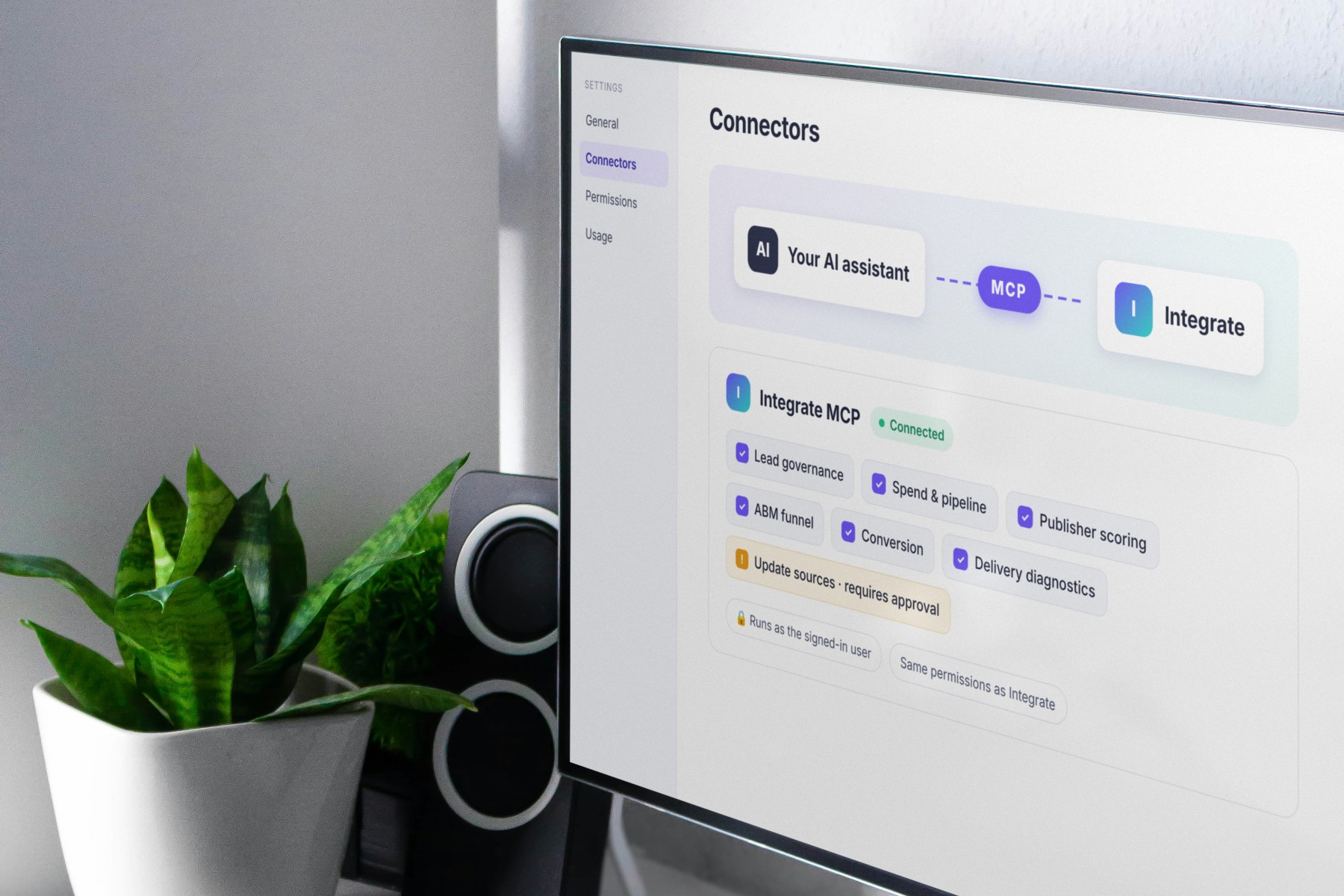
A lead management platform fits between lead sources and your downstream MAP or CRM. Its job is to ingest leads from channels such as content syndication, LinkedIn, Meta, ON24, BrightTALK, event apps, uploads, and web forms, then apply rules for validation, deduplication, enrichment, standardization, and compliance before delivery.
That is the current, bounded role a platform like Integrate can credibly claim. It is not replacing forecasting, opportunity management, sales cadence execution, or full CRM workflow. It is acting as an upstream control point for lead quality and governance, then helping connect downstream outcomes back to source through lead IDs and closed-loop feedback.
What should you measure?
The right scorecard depends on your funnel, but most teams should track:
- lead acceptance rate and rejection reasons, to understand source quality and rule fit
- speed to lead, to measure how quickly records move from capture to usable action
- MQL-to-SQL and later-stage conversion rates, to see whether upstream quality translates into downstream performance
- cost per SQL or cost per conversion, to judge channel efficiency more accurately than CPL alone
- pipeline and revenue by source, publisher, campaign, or channel
- return or recovery rates for bad leads where a closed-loop process exists
Frequently Asked Questions
Is lead management the same as lead nurturing?
No. Nurturing is one stage inside lead management. Lead management also covers capture, validation, qualification, routing, handoff, and measurement.
Is lead management the same as CRM?
No. CRM manages downstream customer and opportunity relationships. Lead management focuses on preparing and governing inbound leads before and as they move into those downstream systems.
Who should own lead quality rules?
Usually marketing operations, in partnership with demand gen and sales, because MOPS is closest to field mappings, integrations, governance, and routing logic.
Where does compliance fit into lead management?
Before the lead enters your MAP or CRM, not as a cleanup step after the fact. That includes validating consent, preserving provenance, and applying region-specific requirements where needed.
Do you still need a formal lead management process if you already use a MAP and CRM?
Usually yes. MAP and CRM platforms process and store data, but they do not automatically solve upstream issues like source-specific validation, deduplication across inbound channels, consent enforcement, or source-level provenance.
About The Author